
Rule of thumb: if your garage door feels stuck or sluggish here in Davie, it's almost never ice — it's almost always moisture. The exceptions are the rare winter cold snaps South Florida does get, when overnight temperatures drop enough to thicken old lubricant or make metal parts contract slightly, and older openers that were already struggling before the cold made it obvious. Outside of those nights, a door that acts "frozen" is being held back by something tied to our humidity, rain, and salt air, not by ice.
Symptoms to Watch For
- The door won't lift at all, even though the opener motor is running and you can hear it straining.
- It opens a few inches, stalls, and the opener reverses or clicks off.
- The bottom edge seems glued to the slab and needs a hard tug or a kick to break loose.
- The door moves, but slowly and unevenly, with a scraping or grinding sound from one side.
- It worked fine yesterday afternoon and is sluggish this morning, especially after rain or a heavy dew.
- The remote and wall button both respond, but the door itself just doesn't move the way it should.
What a Technician Checks, In Order
1. The Bottom Seal Stuck to a Wet Slab
This is the single most common cause of a door that feels "frozen" in our climate, and it has nothing to do with temperature. After an afternoon downpour or a heavy overnight dew, the rubber weatherstripping along the bottom of the door can suction itself to a damp concrete slab, especially if the seal is newer and still a bit soft, or if the slab has a slight low spot that holds water. The fix is simple: a technician checks the seal for cracking or excess give, trims or reseats it if it's deformed, and in some cases swaps it for a seal profile that sheds water instead of pooling against it. If the seal is fine, they'll look at whether the slab itself has developed a dip that's worth addressing separately.
2. Rust and Grit in the Tracks
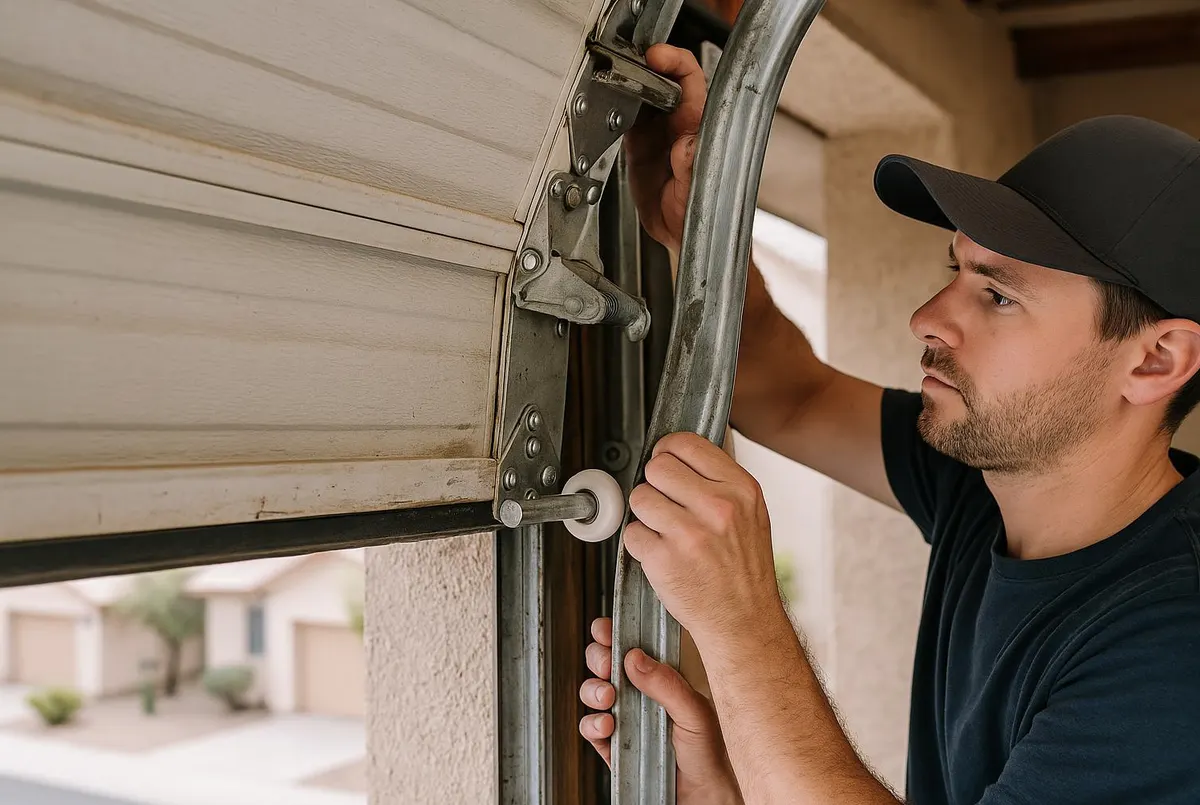
Next up is the track itself. Humidity and, for homes closer to the coast, salt air both accelerate surface rust on steel tracks, and rust combined with blown-in grit from an open garage creates real friction, not just a cosmetic issue. A technician runs a hand along the inside rail feeling for pitting or flaking, checks for debris wedged at the curve where the vertical track bends toward horizontal, and looks for bent sections that only get obvious once a roller catches on them. Fixing this usually means cleaning the track down to bare metal, treating light rust, and replacing a track section if the metal itself is compromised rather than just surface-stained.
3. Dry or Gummed-Up Rollers and Hinges
Rollers and hinge pivots are the next stop. In our weather, the problem is rarely that they're bone dry — it's that an old lubricant has mixed with humidity and dust into a gummy paste that grabs instead of glides. A technician spins each roller by hand to feel for resistance, checks hinges for play or wobble, and looks at roller wheels themselves for flat spots or cracked nylon. The fix is a full clean of old residue followed by a fresh application of a lubricant actually rated for humid, moisture-heavy conditions, applied sparingly so it doesn't just collect more grit later.
4. Spring Tension Affected by Rust or Corrosion
If the door moves but feels heavy, underpowered, or uneven, torsion or extension springs come next. Rust on spring coils doesn't just look bad, it changes how the coils flex and can reduce the lifting force a spring was built to provide. A technician checks for visible rust, uneven gaps between coils, and tests balance by manually lifting the disconnected door partway to see if it holds position or drops. Spring work is one job homeowners should leave alone entirely, since the coils are under heavy tension and a slipped bar can cause serious injury. The fix is either a tune-up with rust treatment or a full spring replacement, usually sold and installed in pairs even if only one looks bad, since the other is rarely far behind.
5. Opener Force and Limit Settings
If the hardware checks out, the opener's force and travel-limit settings get tested next. An opener that was fine when the door was lighter can start straining and auto-reversing once rust or drag has quietly added resistance, which can look exactly like the door is "stuck" even though the real cause is upstream. A technician recalibrates these settings only after confirming the mechanical side is clean, since adjusting force settings to push past real resistance just stresses the motor and the door further.
6. Rare Cold-Snap Effects
On the handful of nights each winter when temperatures actually drop into the 40s here, lubricant can thicken slightly and metal components contract just enough to tighten tolerances that were already borderline. This is almost never the sole cause of a door that won't move, but it can be the final push that exposes a problem that was building anyway. A technician treats this as confirmation to look harder at the items above, not as a standalone diagnosis.
When to Call Davie Overhead Door Co
If your door is stuck, straining, or grinding and a quick look at the bottom seal doesn't explain it, that's the point to call us rather than keep forcing it with the opener. We handle Off Track Door Repair and Cable & Roller Replacement regularly for homes across Davie, Plantation, and Cooper City where rust and humidity are the real culprits behind a door that looks frozen in place. We'll check the seal, the tracks, the rollers, and the springs in that order, find the actual point of resistance, and fix that instead of just resetting the opener and hoping it holds.
If your garage door in Davie, FL is acting stuck or sluggish, call Davie Overhead Door Co and we'll get it moving the right way, not just a quick workaround.